
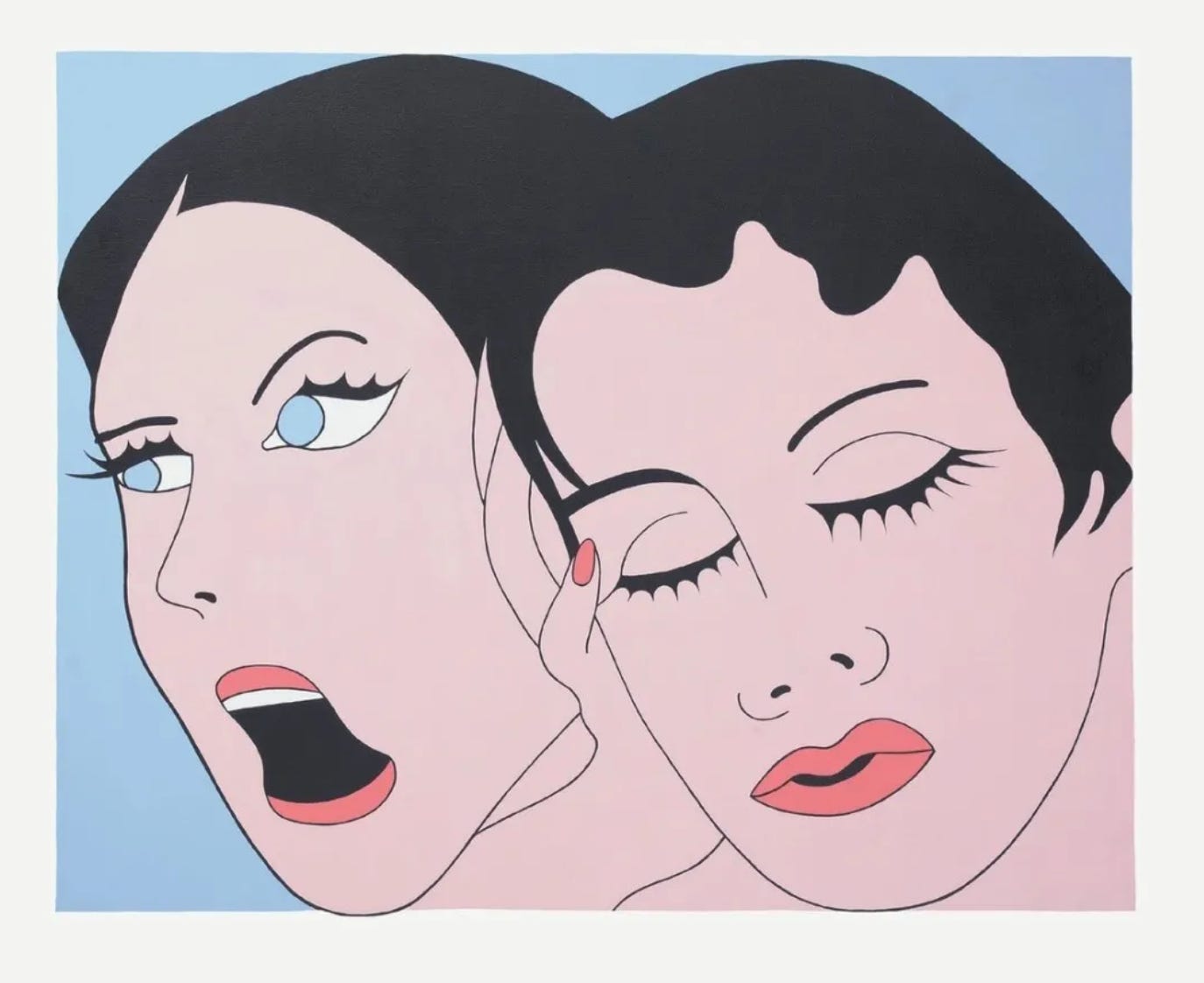
Sleeping (1971), John Wesley
Trauma is a shapeshifter. It plays tricks on our minds, our emotions, our memories. It reformulates our conceptions of ourselves, reshapes reality, distorts our perceptions, unsettles our assumptions.
One of the most identifiable traits of someone who’s experienced real trauma is that they don’t want to call it trauma. How else to cope with the echoes of grief or shadows of fear that live inside your cells, than by reducing these forces to figments of your imagination? You push the darkness underground, but you bury your sensations and your ability to feel joy along with it.
In “Banal Nightmare,” Halle Butler illustrates how trauma reshapes itself into exuberance, control, upbeat determination, and a compulsion to tell cheerful stories about your life even as your reality undermines those stories.
The first line of her novel sounds like a letter to Ask Polly:
“Margaret Anne ‘Moddie’ Yance had just returned to her native land in the Midwestern town of X, to mingle with the friends of her youth, to get back in touch with her roots, and to recover from a stressful decade of living in the city in a small apartment with a man she now believed to be a megalomaniac or perhaps a covert narcissist.”
Then it swerves into traumatic coping territory:
“She was trying not to think about it, trying to have a decent time in her new life, but invariably some bleak thought would draw her back and then the memories would start, vivid, cinematic, relentless, like a brainwashing clip reel for a cult with an unclear mission statement.”
We soon discover that Moddie is an outspoken misfit who’s struggling in the wake of a bad breakup. She’s an underdog in crisis, the easiest character to root for, but Butler dares to make her (and everyone else in her novel) aggressively unlikeable:
“The breakup had been precipitated by Moddie, who impulsively had sex three times with her coworker Toby. He was a colleague, not a superior, but treated Moddie like his underling. He was a foolish man. Toby was muscular and short with a vein that stood out on his forehead, and Moddie liked to publicly humiliate him with casual mockery. She knew no one liked him, and in the break room everyone said that he was “verbally abusive.” Moddie was in charge of sorting the mail and answering the phones, so she knew about his court-mandated anger management classes, which were on Thursdays.”
Moddie knows this guy is terrible. She wanted to take him down. Sometimes attraction takes this shape. “What’s wrong with you?” mutates into casual curiosity, which warps into impulsive choices. Against the boring, polite backdrop of the workplace — and the numbness of a bad relationship — someone awful can seem dynamic or even seductively repugnant.
“After she and Toby had sex for the third and final time, Moddie sat on a park bench to read Walt Whitman. Nick had been out of town on some kind of artistic retreat, but he would be waiting for her when she got home. As she pretended to read the poems, Moddie realized that she had been effectively dead, without a single emotional or spiritual or intellectual stirring in her adult life, until this tyrannical little idiot, a man she had no respect for or interest in, had harangued her into touching his dick in the supply closet.”
Okay, obviously “Banal Nightmare” is a comedic novel, but there’s so much truth embedded in Butler’s exaggerations. This is what provocative art does for us: We’re presented with farce, with revulsion, with “Oh god, get me away from these people!” But underneath that, we’re offered insights that wouldn’t feel nearly as electric in a softer, more gentle story. Likewise, even though Toby is disgusting to Moddie, he offers an escape from her numb state. (Toby also turns out to be an echo of previous trauma in Moddie’s life, but we don’t learn that until later.)
That escape trajectory continues when Moddie dumps her boyfriend Nick (“His brain was rotten, and all of his opinions were inherited, none of them spontaneous, completely rotten.”) and moves back to her hometown. She’s hoping that her childhood friends Nina and Pam will keep her afloat in her new life. Moddie reflects that Nina makes her feel young again:
“…as if she were thirteen and just discovering that it was in fact Nina who would provide her with the constant stream of admiration she needed in order to feel secure, just discovering that it was Nina who would go along with all of her whims and tirades, propping her up and making her feel an authoritative confidence, unlike Pam, who often bristled when Moddie flexed her opinions, and who often seemed — quite on purpose — to adopt the opposite opinion, as if friendship were a debate or a contest.”
I love how hopeful and defenseless Moddie is, lurching toward anyone who encourages her and recoiling in despair when she’s rejected.
In some ways, “Banal Nightmare” reminds me of a more volatile, exuberant version of “Normal People” (or “The Road” by Cormac McCarthy, lol). Where Sally Rooney approaches disconnection and bewilderment from a cold distance, Butler packs all of her vibrant, disastrously flawed characters into a clown car and then drives them off a tall cliff. As the book’s perspective moves from Moddie to her friends to their spouses and acquaintances, we witness how dramatically they misunderstand (and, at times, dislike and resent) each other, bouncing from one nightmare bubble to another.
No one is speaking honestly to anyone else. No one says what they want. (The one character who is direct writes hilariously aggressive emails to all of her friends instead of talking to them in person!) No one admits their weaknesses and vulnerabilities. And even though it’s easy to dislike every single character in the book, we slowly grow to love some of them, and we desperately want some comfort or companionship for Moddie — not because she’s the daring and profound heroine, but because she’s deeply flawed and confused and afraid of the truth, just like every other human alive. As we witness her crawling closer to the truth on her hands and knees, we recognize our own lifelong struggle to do the same.
That struggle returns, year in and year out, for most of us. Because as easy and simple as it sounds to live in reality and be more honest, trauma warps our perception. We’re seduced by arrogant manipulators and we’re fearful of open, trustworthy friends. Our world is deeply corrupt and it’s packed to the brim with fucked up, confused, lonely people whose trauma takes such different shapes from ours that we can’t see them clearly.
Obviously some Ask Polly subscribers will find “Banal Nightmare” too dark or brutal to enjoy. That said, I’d love for those of you who finished the book to tell me what you thought and how you felt as you were reading it. Instead of analyzing “Is this book good or bad?” — a common trap among book clubs, if you ask me! I mean how much do you really gain from a room full of people saying either “I hated it!” or “I loved this one!”?!! — I think it would be more interesting to focus on the psychological journey the book presents and how that relates to your own experiences.
This book club is an experiment! Who knows? But my hope is that we can create something a little richer and more personal than a typical book club. I want us to use each book as a framework for understanding our lives, ourselves, and each other better. It’s not really about saying “This character is bad and immoral” so much as “I have a strong reaction to this material, and this is what it tells me about where I am and what I’m doing right now.”
That’s ambitious! But let’s be ambitious together!
I also think that it’s important that THE PREREQUISITE for engaging in this very intimate conversation is reading the whole book. This will motivate you to read books you might not otherwise read, which is good for you, and it will push you to fight your way through to the end even when you feel resistance or impatience. But beyond that, this prerequisite will ensure that a small circle of subscribers are engaging deeply and daring to talk through some thorny and also inspiring thoughts and feelings together (even if there are only three of us!).
So if you read “Banal Nightmare,” jump right in and tell me your ideas and impressions now. If you didn’t read it, go read it and come back! Each book club discussion will remain active for one week. I plan to come back often to share my thoughts and more quotes from the book, and I want to encourage you to do the same.
Personal anecdotes and digressions are encouraged here. As the world speeds up and becomes increasingly alienating and robotic, we need to ramble and meander and show our human flaws to each other. If it helps, don’t imagine yourself with a glass of white wine in your hand at a party. Instead, imagine we’re having a picnic in an open field on a late August day, we just ate all the bread and prosciutto and green grapes and now we’re lying on our backs, staring at the sky, chatting aimlessly about trauma and bad boyfriends and books and art and life. Dare to get a little weird, and don’t take it personally if no one replies. Weirdness and exuberance are the whole point here.
BUT READ THE BOOK FIRST!
Okay, who wants to start?
Please share this post with anyone you want to join the Ask Polly Book Club with you. This post is free but most future Ask Polly Book Club posts will be paid-subscriber-only because I’d like to create a more intimate, running conversation between a smaller circle of readers. Feel free to suggest other weird, funny, smart books to me in the comments or via askpolly@protonmail.com. Thank you for your support!
Oh I forgot to mention that I want to read nonfiction, too. I'm reading "Four Thousand Weeks: Time Management for Mortals" right now and it's so well-written and thoughtful and helpful so far. I also want to avoid falling into the trap of trying to find novels that are similar to each other. Anything smart and strange and groundbreaking qualifies!
Something I'd particularly like to talk about is the massive plot twist (spoiler alert) ...KIMBERLY WAS RIGHT ABOUT MODDIE THE WHOLE TIME!
Inside Kim's head she thinks, "Moddie was just like that, like some kind of trust fund kid, it was so absolutely disgusting. But, she wasn't even a good trust fund kid, or she wouldn't be here in this stupid little town. If Kim were rich, she'd be better at it, live more interestingly, find a way to make something out of all her free time."
I know Kim The Insane Emailer is the character we all love to hate, but at the end of the book after the financial reveal, this is sentence I remembered the most. Like, dang Kim said the truest thing in the whole book!
Because really, what are any of these people actually doing? The actual practice of art is irrelevant compared to the the academic and reputational hamster wheel they're all running on. It's so...boring!
(I'm not saying the book was boring; it's the most hair-raising page-turner about boring lives I've ever read.)