
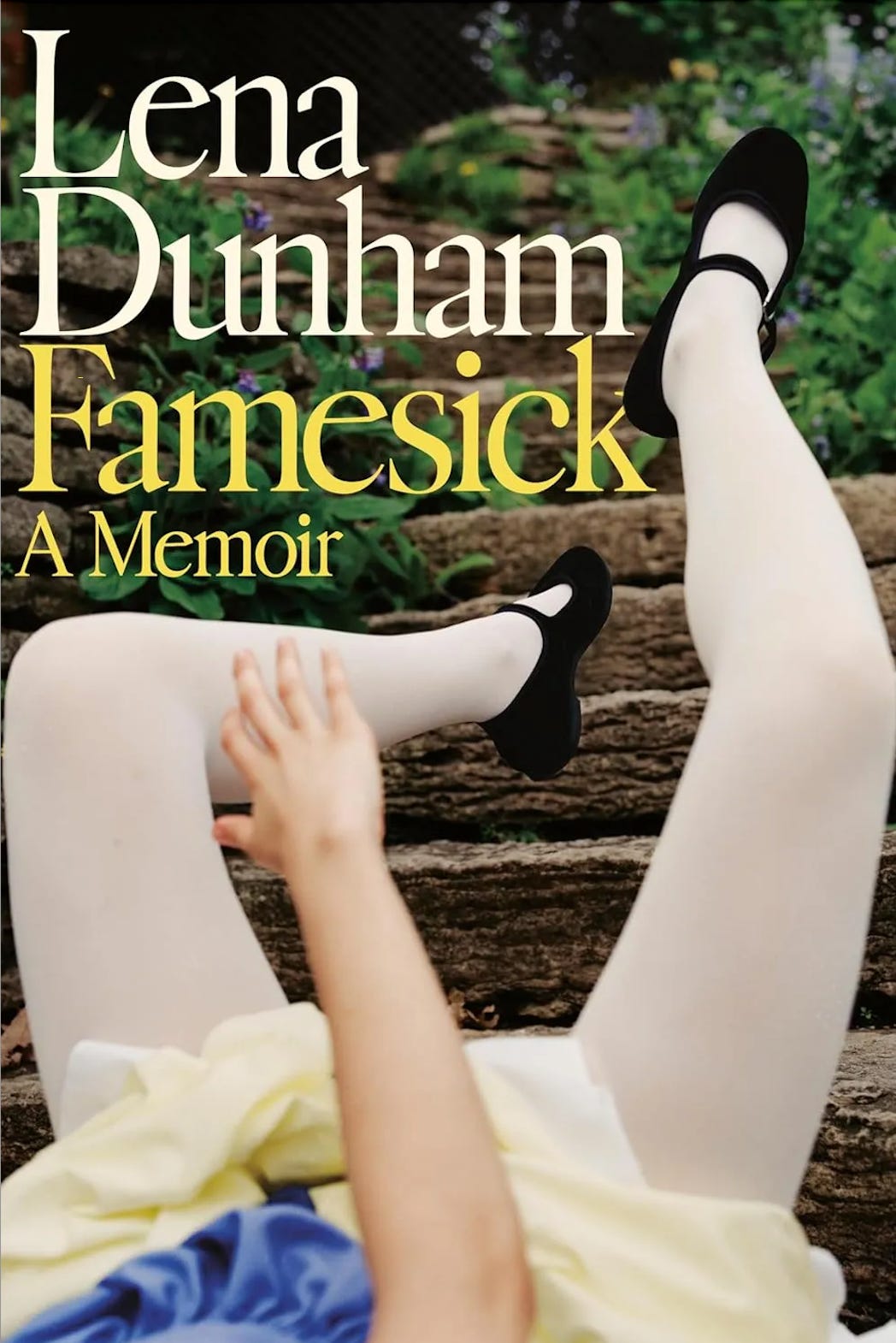
Lena Dunham is very smart and painfully honest.
I know that’s obvious, but these two traits are vanishingly rare among big-time celebrities with careers to protect. So when I saw that Dunham was writing a book called FAMESICK, I thought, Finally, our spy will share the truth about how wretched and harrowing life can be as America’s twisted sweetheart!
Dunham describes her experiences with callous, fickle Hollywood in all of the delicious detail I’d hoped for, yet I still found myself wanting her to deliver a full autopsy report on fame and narcissism and attention-seeking in the age of social media. She has the smarts, the first-hand experience, and a great big bone to pick with the mercilessness of Hollywood and the unrelenting sexism of the internet. Swing that big bone and take ‘em out at the knees, woman!
Unfortunately, Dunham is far less petty than I am. She also had countless other challenges to address in her book, from chronic illness to devastating professional and romantic breakups. After decades of feeling envious of Dunham’s career (I wrote about “Girls” for the New York Times Magazine in 2012, reviewed “Not That Kind of Girl” for the LA Review of Books in 2014, and marveled at the charms of her Netflix comedy“Too Much” for several weeks last fall), I was surprised and even a little soothed to learn just how hard life had been in the midst of her most glorious public victories.
Glory doesn’t erase pain. Dunham knows that better than anyone, and — thankfully for us — she’s willing to say so, even when it costs her a lot. So after finishing “Famesick,” I wanted to ask Dunham more questions about the cursed blessings of fame and the courage it took to expose her biggest mistakes and lowest moments on the page.
The bravery it took to write this book astounds me. I know that’s not really a journalist’s hard-hitting question, but this is what I really want to know more about. How often, if ever, did you tell yourself, as you were writing, that you were making a big mistake? How did you manage to break past that feeling?
Firstly, thank you Heather! Your work has been an enormous comfort to me over the years, and it means the world to hear that the book resonated for you. I really never get over women I respect and admire offering me kind words.
So, to your question: There are a lot of things in life I find very challenging, where I really have to psych myself up, repeat a mantra, remind myself to breathe. These include, but are not limited to: interpersonal conflict, the drop off and pick up windows at the pharmacy, a lot of formal dining scenarios, and — on certain days —getting out of bed. Then there are some things that should be scary that I don’t find scary at all, like uncomfortable medical procedures or (back in the day) being naked in front of many, many colleagues! I think writing this book fell somewhere in the middle, because the process of actually writing — alone with the page or in a back and forth with my editor Andy Ward — I felt enormous comfort in it. I have some form of perverse nostalgia where uncomfortable experiences are actually more interesting and tempting for me to revisit than dreamy ones. I don’t often find myself in a dreamy haze thinking of warm summer days or really fun parties, and am much more likely to experience a curious and somewhat detached play-by-play of moments that, as they were happening, I assumed would go into the mental black box where we often store our pain.
But once that writing process is coming to a close — in this case, after more than eight years — I start to feel a mounting “Why am I doing this? No one is making me do this!” With that, my face reddens as I consider everything that I was not compelled legally to share and yet am sharing anyway. I was explaining this sensation to my very brilliant friend Michael Lewis, wondering why I couldn’t practice more foresight about what is and isn’t going to make me feel like I’m being plucked like a chicken and I’m the butcher, and he paraphrased what I believe is a Kingsley Amis quote (though the world wide web seems not to know it!) that has now become my favorite motto.
A journalist asked Amis some version of “You seem like a nice enough guy, why do you write this stuff?” And he said “Something comes over me when I see a blank page.”
If this is not in fact Kingsley Amis, it remains my motto anyway.
Relatable! I would imagine that a lot of what you wrote about with your continuing sickness felt grueling to put into words. How did you push through on the days when you felt overwhelmed or even just bored with your own experiences?
Writing about illness was a unique challenge, because of the fact that, as a chronically sick person, you become very used to minimizing your own experiences. Sometimes it’s to make the people around you feel better. They’re worried about you, or you can feel them growing tired of a certain kind of monotony. Maybe you just think you feel them growing tired! Sometimes it’s because you have to appear better than you are in order to participate in society. And sometimes it’s just to convince yourself, a fake it ‘til you make it. But that level of subterfuge becomes very habitual, and it takes some real unlearning to offer an honest account of what prolonged illness and chronic pain actually feel like. In terms of what was scary to write, it was certainly the illness chapters, both because looking at it all laid out in a linear fashion is very different than living it, which involves a vague amnesia in order to continue to wake up with something resembling a smile. And there was also the dueling fears: of sounding whiny and of sounding unemployable.
Ultimately, I had to go balls to the wall and conclude that perhaps being whiny isn’t the biggest crime, and that, pound for pound, in terms of sheer grit and hard headedness, no one is more employable than a determined sick girl.
How many rounds of revisions did you go through in writing this book? I ask because the book feels very complete and not at all random or half-finished, which honestly is rare with memoirs these days.
Thank you, and I really have to give flowers to my editor Andy Ward. There are many editors and publishers who, if they have even a drip of gossip and a book that may move some copies based on public interest in juicy tidbits, will rush a book right along and send it into the world practically still bearing its typos. Andy was clear from the beginning that he didn’t want to publish until the book had more than just some stories to tell, but some perspective. Not just a perspective, which is a term that seems to be used to casually mean “has an opinion” or “sees life in a sassy little way!” but perspective in the figurative context, as in seeing events in the proper scale and with a sense of how we relate to those around us.
So the answer to how many drafts is many. I think I stopped counting after overhaul number five. But I feel extremely lucky to have such a diligent coach.
I have to admit that, based on the title, I was hoping that you’d share even more of your ideas about why and how being famous can make a person sick. Having lived in LA for decades and witnessing the weird waiting-to-win-the-lottery mentality that’s common there, I felt strongly throughout the book that you probably have a very coherent and interesting angle on fame and its poisons and ego-inflating, reality-warping dangers. I also think that people don’t talk enough about how confusing an excess of public attention can be when you’re a sensitive person who, like so many artists, is a people-pleaser and grew up craving attention. It’s like what you long for the most actually ends up crushing you.
I am in Los Angeles as I type this, a place I used to come a lot and rarely do these days, and have been sort of re-dazzled by the degree to which fame and its pursuit shape an entire city. Of course not everyone in Los Angeles wants to be famous, but so many of the dominant local industries, even outside of film and TV — beauty, fitness and wellness, medicine, even real estate — seem catered to the idea that celebrities have a different set of needs, standards, and desires (which many of them do!) and that even the people who aren’t famous want to experience life like they do. The word “concierge” is certainly in a lot of business names on these streets!
I have a lot of thoughts on how and why fame has become such a dominant and corrosive force, not just for the people experiencing it but for the people consuming it. There’s that saying “patriarchy hurts everyone, even men” and I believe that celebrity hurts everyone, not just celebrities. The reason I was shy about perhaps stating that stuff more baldly was two-fold: I’m a memoirist and not a cultural critic, and I worry that really laying into society en masse can feel like the medicine going down with very little sugar. And I also love my job and my life as it exists today, and to have that life I still participate (if to a lesser degree) in the machinery of celebrity. So it would be a bit like a current Meta employee warning you about the dangers of your social media use.
I will probably spend the rest of my years trying to understand and reconcile the instincts of an artist and some of what’s involved with maintaining a life as one. I try to find what’s interesting about that tension, or at least what’s interesting to me, and to engage in a way that doesn’t create a schism between what I believe and how I behave, which we all know is a schism that can really swallow a person up.
Do you have any dread that wells up around attention in general, like “Oh no, they all seem to like me now, this can only go downhill from here”?
Yes! It seems very silly to say I’m shy, considering my track record, but a lot of performers are actually introverts. As someone who spends more time behind the camera now than I do in front, I see this a lot — that performing is actually a way to escape an overwhelming sense of introversion, to take a vacation from self. Writing is very similar, a way to connect while also being, essentially, alone. So, even if I had not experienced the shifting tides of public opinion, the experience of sustained attention, no matter how warm, always comes with a bit of a hangover.
And of course I am also much more aware at forty, both because of what I’ve witnessed and what I’ve felt — even what I’ve felt as a “fan” — of how fickle a mistress good buzz is. The thing about getting older is you can wear it all much more lightly. You don’t have to live or die by whether your shares are up or down, and there is an understanding that both experiences are equally fleeting. It’s possible, with some practice, to be very grateful for a positive connection with an audience or reader, while also knowing it’s not the defining metric of one’s life.
So true. Unfortunately, I think I wear some things more lightly for a while and then surprise myself with my bratty attitude all over again! Which is related to my next question: As someone who probably has had regrets about sharing vulnerably and at times guilelessly with complete strangers, how do you figure out how vulnerable you want to be and how much you want to share from day to day? Have you landed on a philosophy of vulnerability and honesty and sharing that feels right and comfortable?
I ask because a few weeks ago I answered a letter about this, and my perspective was: EVERYTHING IS ALWAYS FUCKING CHANGING, SO FORGET DECIDING ONCE AND FOREVER ABOUT ANYTHING! You can say “Share everything! Be honest!” one year and then feel like living in a cave underneath the sea the next year.
On the other hand, I repeatedly discover that as a writer and as a person, the more vulnerable I can be, the more honest I can be, the happier I am. And nothing I make is fully alive and dynamic if I’m not a tiny bit uncomfortable, underneath it all, with how much I’m sharing. The discomfort contains a kind of energy and magic that attracts more energy and more magic. Wow, this is not actually a question!
I agree with absolutely everything you just stated!
The things I’m embarrassed about aren’t really in my art, because I do believe art is a document of who we are at the specific moment we make it, and it’s a lovely thing to have a record of all of that change. It’s the same reason I haven’t had any of my tattoos removed, because the girl who wanted an Eloise at the Plaza tramp stamp is just as real as the young woman who got a hairless cat’s head tattooed on her left shoulder and they are both still in conversation with the slightly-too-old-to-have-done-it chick who tattooed a rosary with pills on her foot.
I am much more embarrassed by the record left by social media, which captures moments where I thought I had it all figured out and really didn’t, or when I glibly portended my own doom. And I think it should literally be illegal to Instagram any lover unless you’ve been partnered for more than five years OR you’re modeling some sort of radical transience!
You have many talents and opportunities and seem to be surrounded by great people who love you. Sometimes that embarrassment of riches must feel like a form of pressure and cause a little guilt over how best to spend your time. How do you decide where to place your focus, and how to prioritize competing projects/ places/ people?
One thing that my periods of more severe ill health have taught me — and this sounds like a bad meme affirmation, but it’s true — is to deeply appreciate periods of stability and abundance. I had a few moments where, when faced with a medical crisis that would not seem to resolve, I looked back at how little attention I had paid to how good my life was, how deeply I had focused on my own shortcomings or aesthetic failures or any number of woes based in a sense of lack, and I thought “If I’m ever lucky enough to get out of here, I will be thankful for everything I was too myopic to be thankful for.” Of course, there are some days where that takes more work than others, but it’s become a pretty natural practice: to feel lucky for the basics, and dazzled by any extras.
That being said, I do still have to work hard at being decisive about how, where, and with whom I spend my time. Despite my knowledge that our days on this planet are, in fact, limited (and my energy is also limited, even when I’m stable, just by virtue of my health picture) I still find it very hard to say no to an opportunity or an experience if it’s offered. Sometimes it’s because it seems right on paper. Sometimes it’s because I think I should be the kind of person who wants to (or can) do it, and the dutiful little soldier in me is activated. Sometimes it’s because I get back into a cycle of guilty “supposed to’s” and sometimes it’s because I am a curious little fucker who wants to gobble up experiences like all the sides at a Vegas buffet.
My body’s sensitivity can be frustrating, but it’s also an excellent thermometer. Because if a situation or project or relationship is not right for me, and I’m burying that in my subconscious and going in circles making internal justifications, my body does not let me off the hook. It will always come to the surface somehow, and often a strong physical response is my first clue. So I’m really trying to do the work of being honest with myself before I have to, say, break out in hives or go down with a dazzling migraine. That’s a strategy we develop early, our mind-body trying to protect us in ingenious and maddening ways, and it takes a long time to unlearn.
What I value most in projects is: learning, being amused, and collaborators with whom I have a mutual respect and understanding. What I value most in people is openness, loyalty, the ability to change and let others do the same, and a sense of the absurd. And what I value most in places is being cozy and delighted. We can’t have all of that all of the time, but I try to assess based on my values and not the common value the world places on a job, relationship, or experience.
And of course, sometimes something or someone unexpected just lights you up and you have to say fuck it and dive in.
I would characterize a lot of my struggles over the course of my life as an uncanny and difficult-to-describe battle against self-hatred and shame. I recognize hints of that in both of your books, and I wonder if you could describe to Ask Polly readers the shape that shame took when you were younger and how you got a handle on it over time. How often do you feel a bad sensation these days and say “Oh that’s shame, let’s toss that shit so we can see things more clearly!”?
Love your use of the word uncanny here! Defined as “strangely mysterious, eerie, beyond what is normal or expected.” That’s such a great way to describe shame, an emotion that, for many of us, feels a bit like a ghost twin we were born back to back with but cannot see. It’s a fact in my life, in so many lives, and yet it’s invisible, amorphous. And the deeper we dig to look for its roots, the deeper they seem to grow. My father used to say “Shame is such a waste of time!” as if the feeling could be tossed into the washing machine like a dirty sock. But an understanding that shame is not serving us and an ability to dismiss it are two very, very different things, and, unlike trauma or anger or heartbreak, I have not found that talking about the feeling has really gotten me any closer to freedom.
I remember the feeling of doing something “bad” as a kid and walking around with a mounting dread, until it became absolutely untenable and I’d blurt whatever had happened or whatever “bad thought” I’d had to my mother. And nine times out of ten, her look of concern would break into suppressed laughter, as she tried to take me seriously and explained that I had not, in fact, committed a mortal sin. That’s why I know shame is often deeper than our circumstances: because my parents never, ever made me feel that I had anything to be ashamed of, and yet, from the moment I was conscious, there it was.
I do, however, find that the great antidote to shame is honesty. Because hiding is one thing I can say for certain begets more shame. It’s one of the reasons I have gotten so much from your columns. Your answers lay bare your own complex and knotty emotions, which is of great comfort to your readers and to the person seeking advice, but it also seems that the very act of asking the question, of writing in to Polly, is a sort of shame release valve. What a beautiful thing!
Oh man, that’s so nice to hear. And it’s true, honesty does heal shame like nothing else can. But it’s counterintuitive and it takes a lot of courage to keep showing up for it.
Do you know what your next book might be? Anything else that you’re currently working on? Any skills or hobbies that you want to pick up along the way?
I have been kicking around a novel — an epic romance for people who find romance gross! I feel it following me around and nibbling at the edges of my attention. And, like the early days of an intriguing flirtation, that’s always an exciting space to be in.
We all have an area of our life that tends to command the most focus, and if I don’t keep it in check that’s work for me. Ever since I was a little kid, I was obsessed with having an occupation. I didn’t just go to musical theater class, but read 1000 unauthorized Barbra Streisand bios at the same time. I took a sewing course and then spent nights and weekends cutting pictures out of old issues of Vogue. And when we got our first desktop computer, I sat down at it as if I were in the Times newsroom on deadline. Maybe that came from growing up with my parents working at home, and seeing the way their social and professional lives were intertwined. When they weren’t making art, we were going to galleries and museums and studios. Supposedly, as a toddler, I interrupted a dinner party they were having to shout “Art! art! art! All you talk about is art!”
This is all to say, I may have come by it naturally but I have to remind myself that there’s a big wide world out there, beyond either my bed-office or a movie set. I recently made a list of 40 things I want to do after 40, and it was such a cool exercise. It was honestly pretty hard for me to even come up with twenty things that were not professional goals, and it was a chance to ask myself “What gives me pleasure, what inspires me, what do I think is important and how do I define myself outside of my professional aspirations?” The answer cannot just be bidding on vintage clothes online and kissing the cheeks of fat animals, although it’s largely that.
What do you love about being where you are now — the age you are, the perspective you have, the milestones you’ve experienced? What feels challenging or emotionally perilous about where you are?
I turned forty a few weeks ago, and cannot seem to stop announcing it to people. There’s something about the number, especially as a woman, that is just so cool, chic even. It signals experience, self-knowledge, and having survived. Usually a birthday feels like an arbitrary celebration, like I’m getting gifts and cake for the simple fact of my parents having procreated — if anything, we should be giving my mother gifts for the c-section and postpartum depression she white knuckled through. But this one actually feels like an accomplishment! Four decades of bobbing and weaving, and somehow forty feels like standing with both feet firmly planted. I’m very proud to be here, and I love talking to other women about what being forty represents to them.
I also have enough experience to know that life just keeps on life-ing, as the kids say, and that stability is a pretty illusory thing. When you’re young, you just don’t know enough to understand how much is coming for you. At forty, it’s impossible to deny that life can be terribly unfair and that change is the only constant. It’s impossible to be blithe about how brutal the world is, or to look the other way. There are days — if I haven’t slept properly, if I’m having a health flare up, if the news of the world has been especially dark and daunting, often all three — where the sheer endlessness of it all feels very hard to face. And you can’t really talk yourself out of it, only move through it with some measure of sincerity and grace.
The only thing I miss about being young is the naiveté and obliviousness. But I had a pretty good run with both of those. I was lucky to get any time with them at all!
Oh, and not having to wear a bra. Older women told me that it wouldn’t last forever, and I didn’t believe them. If I ever get too big for my britches, I need only remind myself of being measured for my first real bra at thirty nine and I’m put right back in my place.
What kind of wisdom or insight might you have to share with younger people who are besieged by longing and creative impulses and a driving desire to be loved for exactly who they are?
One of the hallmarks of being young, at least for me, is an enormous amount of desire without a vessel to pour it into. I was sloshing desire all over the place, and often in the wrong directions. I was lucky — and so much of it really is luck — to find my means of creative expression fairly early and to get an actual shot at doing it. But all the rest — friendships, romantic love, finding some semblance of self-respect — was messy and painful and endless.
If I could go back and tell that person one thing — and I’m not sure she would have listened, since she thought that having read Joan Didion’s essay on self-respect and enjoying Joni Mitchell’s less popular albums and carrying around a dog eared copy of Nikki Giovanni’s Love Poems meant that she had it all figured out — it would be to have some patience. The desire to be loved for exactly who she was made her twist herself into shapes that didn’t resemble her at all. The need to be understood made her say things that she didn’t mean. She wanted it all and she wanted it right then, and it often meant pretending that she had found it already.
Everything is a journey. We arrive at the destination on our itinerary, only to learn that there may be a better view ten miles ahead. Getting comfortable with being in transition, in progress and unfinished is the work of a lifetime, but it’s never bad to get a head start.
Getting comfortable with being unfinished is the work of a lifetime! Write it down and tape it to your foreheads, kissable animal buddies! Lena Dunham has a new newsletter here and you can buy her memoir Famesick here. I also recommend her Netflix limited series “Too Much.” And if you haven’t watched “Girls,” my god, get on that!
Your support keeps this place going, and makes it possible for me to do interviews like this one and share them with all 130k free subscribers. Please consider subscribing today!
What a gift this particular Ask Polly column is Heather. No matter who we are or how important we may appear, god, aren’t we just the same. As always, thanks for providing proof that human kindness, intelligence, honesty and connection exists. ❤️
This was a lovely and heartening read.
Everything in this paragraph was relevant for me and I really really appreciated it:
"Ultimately, I had to go balls to the wall and conclude that perhaps being whiny isn’t the biggest crime, and that, pound for pound, in terms of sheer grit and hard headedness, no one is more employable than a determined sick girl."