
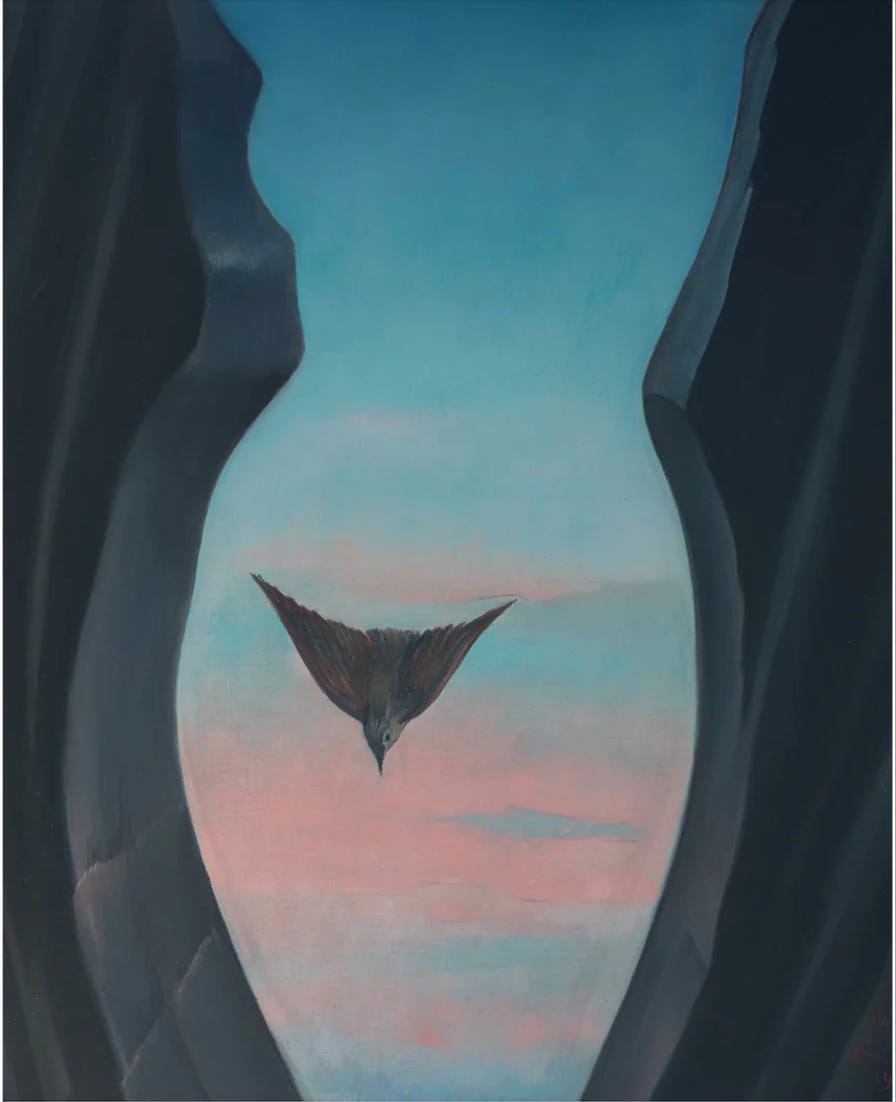
The Holy Spirit (1965), Jane Graverol
“If personality is an unbroken series of successful gestures, then there was something gorgeous about him, some heightened sensitivity to the promises of life, as if he were related to one of those intricate machines that register earthquakes ten thousand miles away. This responsiveness had nothing to do with that flabby impressionability which is dignified under the name of ‘creative temperament’ — it was an extraordinary gift for hope, a romantic readiness such as I have never found in any other person and which it is not likely I shall ever find again.” — The Great Gatsby, F. Scott Fitzgerald
For decades, everything hurt my feelings. When someone decided I wasn’t their favorite, I always took it personally and dreamt up rebuttals or reasons why they weren’t good enough for me, either. When friends made plans that didn’t include me, I felt hurt and I always assumed there was some negative reason for it. I was being rejected, I was being excluded, I wasn’t as loved as I deserved to be.
There was an essential misunderstanding living at the heart of my worldview: All data collected from other people was used to form a verdict on my lovability as a human. This perceived verdict, when combined with the preexisting shame of being sensitive, expressive, anxious, a woman, smart, exuberant, ambitious, open, envious, expansive, formed an explosive engine for feeling disappointed in other people, angry at myself, and afraid of further rejection.
But I was a good storyteller. So I told stories about what was wrong with people, what was wrong with me, what was broken about the whole world. Many of these stories were persuasive, disturbing, compelling. Some of them were accurate. But whether they were accurate or not, my stories blocked me from other people and cut me off from my feelings. My stories hobbled my ability to show my generous and loving heart to the world, and to build from that generosity and love. My stories prevented me from seeing the truth, that getting my feelings hurt easily is part of what makes me who I am.
That’s why my offering to you on this gray December morning is this: I want you to understand, in your heart, inside your bloodstream, deep in your marrow, that everything will always hurt your feelings and that’s a good thing. In the words of F. Scott Fitzgerald describing Gatsby, you have something rare and special, a “heightened sensitivity to the promises of life,” “an extraordinary gift for hope,” “a romantic readiness” that’s precious and worthy of respect.
Those I’ve met who have this romantic readiness get their feelings hurt all the time. Their feelings are hurt by the smallest things. If they’re in an open, welcoming state, they’re also in pain some of the time. For this reason, they often expend a lot of energy shutting down their emotions, keeping the world at arm’s length, or telling stories about what’s poisonous or wrong about the world in order to justify their defensive stance. That would be okay, I guess, if that protective crouch didn’t so often render them depressed, cynical, anxious, skeptical, remote, or all of the above.
You can recognize these fallen romantics easily if you start to pay attention. And if you listen to them talk, you’ll notice that they always talk about the features of the world that crushed them instead of just telling the truth about where they are right now, how they feel right now, what they want to build and enjoy and savor and relish right now. When someone refuses to speak about the present, often they are afraid of the present, they are hurt by the present. They are fleeing from who they are, so they believe that honesty isn’t an option.
I’ve fit this description on and off during the course of my life, in spite of my repeated and downright strenuous efforts to stay open and optimistic. When everything hurts your feelings, you have to exert a huge amount of energy to endure it, to notice that it’s happening, to feel it, and to dare to stay open and hopeful and loving anyway. You will be tempted to choose anger. You will be seduced by big distractions. You won’t want to stay where you are and do what you know you love to do. You won’t want to trust that good friends who withdraw or disappear or make plans without you still love you. You won’t want to believe that people who seem to reject you didn’t remotely mean to send that message, or they were busy, or they are good humans who just don’t belong in your life at this time for a number of simple, concrete reasons that have very little to do with how lovable or worthy you are.
Your feelings will have you telling self-protective stories. You won’t want to challenge them, because those stories make you feel righteous and untouchable. But I’m here to tell you that the most fragile and unnerving facts on the ground will make your life feel more full, will make you more confident, will calm your nerves, will give you more hope in spite of everything: You are built to be hurt because you care too much, and that’s not just okay, it’s exquisitely beautiful, it’s sublime, it’s the source of your power and your desire and your passion.
When you admit that everything hurts your feelings, you can finally let the world be what it is without telling aggressive and negative stories about criminals who couldn’t see you clearly, couldn’t appreciate your love, couldn’t respect your ideas. Even if these crimes are real, even if these criminals exist, once you loosen your grip on your stories about them, and stop repeating and clinging to those stories as a form of self-protection? You feel free. Your anxiety fades. Your optimism surges.
Why? Because you’re aligned with reality. Reality is this: Your heart is very big, and you will always care too much.
When you’re aligned with this truth, you recognize that your huge heart makes it very, very frightening to invest in what you love. Your heightened sensitivity makes it extremely difficult to stick with the people, places, and things that light you up the most. Your ebullient soul will sometimes abandon what you need the most and you won’t even know why. You will simply lose the thread, get distracted, move on, withdraw, and you won’t recognize what you’re doing. You will pull back from exactly what you’re the most passionate about, and you won’t realize it until later.
But when you dare to feel the pain of being what you are — a sensitive instrument, an open window, a tiny bird perched on the shaky limb of a huge tree in a windstorm, fragile and uncertain and volatile and wildly alive — you gain renewed respect for yourself. You understand why the world is so hard on you. When you respect this pain, you can feel vibrant inside your sensitivity, passionate inside your fear, hungry inside your anger, soulful inside your sadness, brilliant inside your anxious need for more love.
In other words, feeling as easily hurt as a fragile bird doesn’t necessarily need to include all of the negative associations we have with sensitivity. The world can misunderstand you as needy, as desperate, as confused. Our culture will always tell reductive stories about what it means to be open and expressive, honest and attuned. Other people will always have their own self-protective stories. The most important thing is that you resist the bad habit of turning your own defensive stories against yourself, creating neurotic smoke and shaming mirrors out of your own softness and bewilderment, which lives at the sweet center of who you are and is precious beyond belief.
You have a romantic readiness that is divine. Your stories about why people do what they do are just distractions. They dim your vibrant colors. Whether these stories are accurate or not, they cause you to withdraw into the anxiety of a small child. These stories explain the world to you in primitive, childish ways, a survival mode you used when you were younger in order to understand what was happening around you. But the romance and exuberance and power that live inside you right now, as an adult, are insulted by these old stories, whether they’re accurate or not. Because your most robust and romantic self wants you to feel every drop of hurt that you feel now while also moving forward, into the chill of the morning, through the frozen grass, in search of new sensations and new adventures. Your most vivid self wants to keep getting its feelings hurt in brand new ways, without fear, without shame, without hesitation.
Admitting that everything hurts your feelings is a way of respecting your gigantic heart and honoring the truth of who you are. It’s a way of staying invested in spite of the pain. It’s a way of sticking with difficult people, places, and things that blossom and fade and evolve and bring you joy. It’s a way of demonstrating to the world that vulnerability and softness are not inherently desperate or clingy or self-serving. You are aligned with your most fragile and also your most robust selves, so you can heed both. And slowly, you will understand when to dive in and when to let go. You will be able to say goodbye and leave instead of staying forever, guiltily. You will also have the strength to stick around and see what happens next instead of creeping away out of fear. And when things get difficult, you will find that the easiest path of all is to tell the truth.
Refusing to tell the truth, let go of the past, and honor his big heart is what made Gatsby tragic. He transmuted his wide-ranging sensitivity and sensuality into obsession, and got caught up in signifiers of value instead of valuing everything he naturally was, everything he already had — the love inside him, the air, the sky, the wide, cold ocean outside his door. Dissastisfaction and longing are sometimes just a self-protective distraction, a way of denying reality, a way of tricking yourself into believing that you will never be enough, when you’re more than enough right here, right now.
To escape that fate all you need is honesty. You can tell the truth, plainly, without apology, without fear, even when that truth includes the statement: Everything hurts my feelings. This is who I am. I care too much.
The most fragile and unnerving facts on the ground are also what make you so dazzling, so sharp, so resilient. This is the source of your power and your desire and your passion. Don’t wish it away. Don’t hide it. Don’t hate yourself for it. Respect it and love it with all of your heart, and watch the whole world blossom around you, watch love rush in to embrace you, watch the trees stand by your side, in solidarity. Don’t forget this. Don’t lose who you are.
Thanks for reading Ask Polly! Today until Monday, get a yearly paid subscription for 50% off for one year. This offer won’t last and it will rarely be repeated, so this is your day to go for it! Please forward this to your friends who might want to know about it.
I needed this so much right now. Thank you for writing it.
Good god this spoke to me today: I have been reeling from some negative feedback, and then in a doom spiral about my lack of resilience and how much it hurt me. Thank you!