
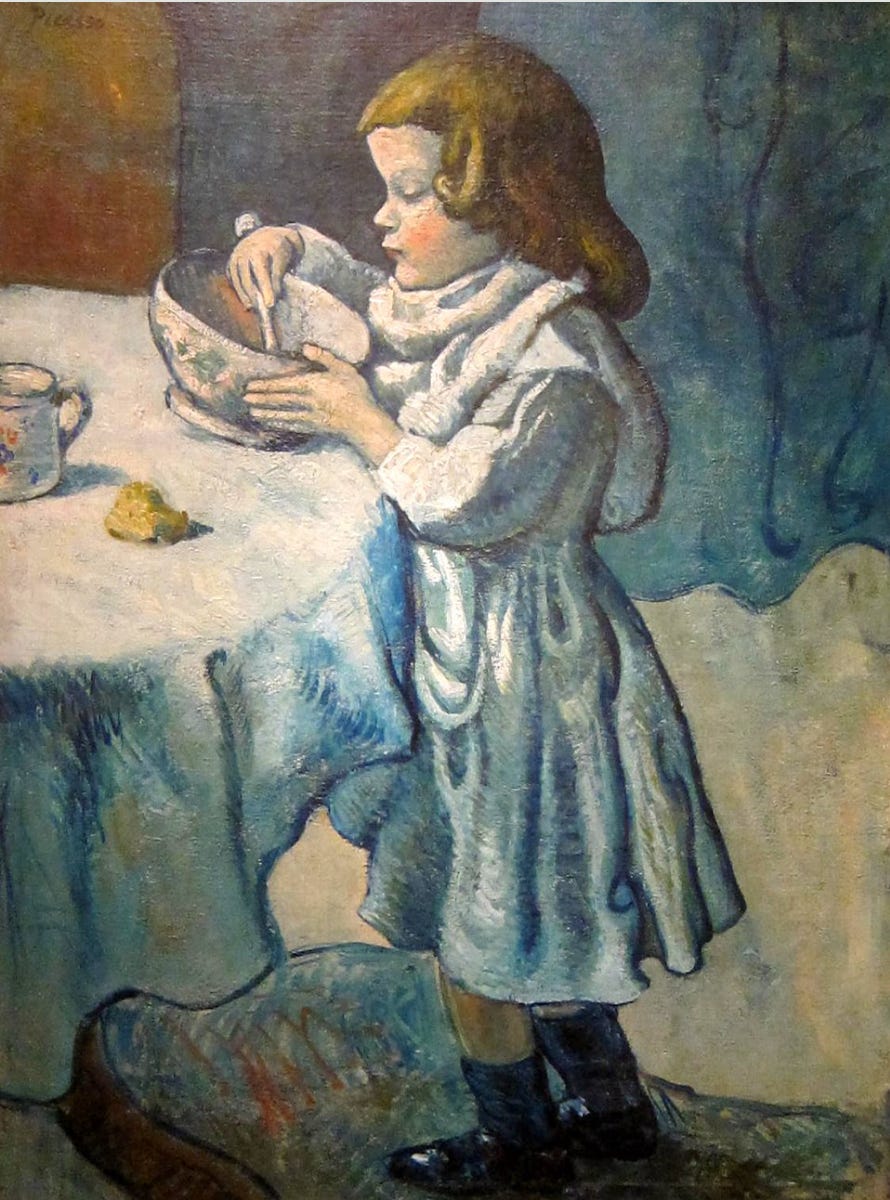
Le Gourmet (1901), Pablo Picasso
Dear Polly,
I have written you two letters over the last ten years, and every time the act alone gave me some peace of mind. I am, too, a helpless cliché, but since you embrace us, I’m writing again.
Five years ago, I met my now ex-partner. I was five years into living in a new country, and had gone through a lot of growth. I had ended a long-term relationship I felt constricted in, moved in with friends and had the time of my life, had a major friend break-up just when the pandemic started, realized the career I was in didn’t work for me, and got way too invested in a series of situationships while pretending not to want anything serious. I had such highs, but also such lows. I realized that I was very codependent and anxious, and I did a lot of work to love myself better and feel comfortable alone.
I was ready to get started with life and own my desires. I made a few bold choices: move to a different living arrangement, get back to university to start a new career, and date in a new, regulated way. I quickly met a new romantic partner, and did all the things I’d never done before: spaced out our first dates to not get too invested too quickly, communicated early and clearly what I wanted from a relationship, told him when I was frustrated by his behavior, gave him time to show me what kind of person he was in ambiguous situations. I felt safe, loved, and cared for, and started believing again that a long-term relationship could be fun and sustainable.
But he is struggling with severe depression, and three years into our relationship he began gradually pulling away from everyone in his life. He was incapable of imagining a future for himself, let alone with me, and became more and more avoidant. The dynamic between us veered increasingly codependent. He was very good at being there for me from a distance, texted me every day, was always available for a phone call, but didn’t show up for dates we had planned because he had fallen asleep, told me often he was spending time with me to please me, because he almost always wanted to be alone, and even then, was often self-absorbed and miserable. I was careful not to show too much frustration or hurt, afraid that he would clam up and that would ruin the few moments we spent together, and aware that I couldn’t understand the pain he was going through. From time to time, he would feel better and I could see a glimpse of the man and the relationship I had fallen in love with.
A few months ago, he pushed me to the edge and I broke up on a whim, after two years of hoping he would get better and things would not only return to normal but keep progressing. It is definitely the right decision, but God, is it painful. I miss him a lot, even though I’m hopeful we can, one day, be friends. He is a great person.
Mostly I miss the hope, the safety, and the excitement that this relationship used to give me, which I believed could return. I felt such intense relief that I had met him, that I was finally in a safe, loving, exciting partnership. The way it crashed down and caused my old codependent patterns to flare up really frightens me. I am scared I’ll never manage to be in a healthy, committed relationship, and the world feels so lonely and unsafe since the break-up.
This didn’t happen in a vacuum: My new career is at a standstill. I’m still working in the same old job I tried to put behind me. I know I’ve learned, grown, and made progress in the last five years, but here I am, older, single, still working a job I don’t want to work. It’s hard not to feel like I’m unable to get where I want to go. It’s also become crystal clear that I was investing so much energy taking care of him and trying to salvage this relationship that I let myself down. I’ve got friends, hobbies, projects, but nothing feels exciting without this relationship in the picture, and I don’t know how to start feeling whole again, at ease in a life that feels big and secure and beautiful, and where I am my own center of gravity.
I guess what I am asking is, how do I find myself again when I am so vulnerable and life feels so grim? How can I build up faith that a loving and committed partnership is possible for me, after seeing how this beautiful relationship turned sour after a few years and how quickly I can lose myself?
Way Off-Center
Dear WOC,
Getting lost by surrendering to fantasies about our brighter, better futures is a constant temptation for all of us these days. If you’ve ever cared too much about someone who was half-absent, if you’ve ever committed to an impressive job that you should’ve run away from, if you’ve ever been addicted or obsessed or fixated or filled with escapist longing — and who hasn’t? — there is always a chance, no matter how beautiful your life is, that you’ll trip and fall back into a delusional hole or get swept up by a self-deceptive tornado or leap into a seductive but ultimately imaginary abyss. When you want a LOT out of this life, and you tell very good stories about how you’re improving and things are getting better and everything is about to be amazing, you are going to LOSE YOURSELF over and over again.
But being lost is actually the good part. Because when you wake up and stop following random trails of breadcrumbs and you notice that you’re somewhere new and scary that you’ve never been before? And reality was different than you imagined? And now you’re on your own and the woods are getting darker and darker and you blame yourself for this and you want someone to come and save you from it?
That’s when you learn a lot very quickly. The most important thing you learn is HOW TO TOLERATE THIS MOMENT. Yes, this one. How to breathe and open your eyes and exist without piping despairing stories into your head. How to feel your sadness. How to step outside and look at the trees and feel flat and empty and uncertain.
But let’s go back to everything that went wrong for you, because right now you’re tempted to feel ashamed and sick and embarrassed about how you landed here yet again, and that’s making your storytelling mind buzz and whir and grind its gears: Did you notice how I blended up all of the obvious mistakes (codependence, fantasy, delusion) with a lot of things that are supposed to be good for you (self-improvement, optimism, building your own bulletproof religion, self-trust)? I did that because that’s how it feels to be a sensitive, thoughtful person who cares a lot about building a great life — and is willing to say so and make big moves and change bad habits. You’re so intense about what you want that you work very, very hard around the clock to FIX what feels a little off, what doesn’t quite fit, what isn’t quite right yet.
That constant, slightly neurotic, slightly anxious FIXING — fixing not just your own problems but also trying to fix everyone else’s — is what makes a codependent. It’s what makes a person prone to fantasy and obsession. But it also makes a person ambitious and successful. It’s what makes a human active and charming and socially adept and assertive and rapacious.
The problem with constant fixing and striving and polishing your behavior and telling newer, better, more optimistic stories about where you’re headed — all seemingly healthy things! — is that you often start to confuse the difficult, exhausting work you’re doing with healthy, fulfilling work. You also start to confuse your anxious stories that focus on set outcomes (“My partner will feel better and learn to have fun with me and commit to building a future together!”) with not just hope, but present happiness.
For a long time there, you were engaged in a battle that was entirely focused on an imaginary fixed point when all of the suspense of the present would be resolved. Your story about that future — a set outcome that was so compelling that you were willing to ignore your emotions and your body and the drab realities of your day-to-day life in pursuit of it — was keeping you going. You were running on empty but your head was filled with fantasies. You were falling to pieces but your stories were still shiny and soothing.
In other words, you were an addict.
All of this will feel like overstating the facts, and that is EXACTLY what I’m doing, in order to demonstrate to you that your reality has actually improved even though it feels much, much worse. You’re kicking a drug right now and that sucks. But objectively, your life is better than ever, because that guy didn’t make you feel good in the present at all. He was exhausting you and you just kept working harder and harder to fix that, and your relationship, and him, and everything else.
The working harder and harder part felt good to you, because working hard often feels good to hard workers. Working hard on doomed things can even feel good, when you’re a person who doesn’t know how to enjoy the present. The telling-stories-about-the-shining-future part feels very good, too – that was what you did to keep working so hard, to keep tolerating the blah and lonely present realities of a boyfriend who couldn’t show up emotionally, had nothing to say, and preferred to be left alone. Instead of saying “What the fuck, man? Bring something to the picnic or take a hike!” you were gentle and patient and tried not to pull him into reality, because that would force YOU to enter reality, TOO.
I know your intentions were good and you love him and he’s a great person — he can still be a great person, don’t worry, but that doesn’t mean you have to look forward to being his friend some day. (Imagine for a second NOT befriending him, and unexpectedly loving that journey for you.) The point is, you’re someone who loves to work so hard on something doomed (and therefore very romantic!) that you ignore your feelings and your body.
That’s part of the reason why suffering worked for you. But receiving upbeat, bullshit texts from your boyfriend also felt great: That was how he kept you addicted to hope, and maybe even kept himself addicted, in spite of the fact that before and after he tapped out those texts he felt not so great or was looking at porn online or was sinking into some other flavor of digital and biochemical abyss.
None of us are above this! Let me be crystal clear: This scenario isn’t some rarefied, exotic, dysfunctional realm that only you and your partner inhabit. MOST HUMANS LIVE THIS WAY NOW.
Likewise, your reaction to your situation — working harder and harder, telling bigger and brighter stories about how everything was about to change, offering more and more support and love and help to your partner as he slowly demonstrated that he no longer had the desire to work hard at anything, including your relationship — can be recast very easily as functional, healthy behavior in our world. We’re all such out-of-body, distracted, confused addicts with so much angst and longing and anxiety swirling around inside our cells, and our culture is so good at tricking us into believing that we need to do absolutely arbitrary, worthless, ridiculous, and also deeply addictive things to stay ‘sane,’ that it’s very difficult to separate grounded, healthy actions from delusional actions. We can’t tell our good stories from our bad stories. We don’t know if we’re working too hard or not working hard enough.
We — not you, but all of us! — are deeply confused. We’re confused because the stories that we’re told, and therefore the stories that we tell ourselves, are getting slicker and brighter and shinier and more addictive to believe.
Complicated, slow ways of getting to know someone and understanding them and spending time with them, and trusting our bodies when things start to feel wrong, have been replaced by instant dates with impatient and mostly virtual humans who can stoke the fires of our affection very quickly from a great distance, cheered on by a chorus of facile self-help gurus who can swiftly opine “more open communication” and “more supportive talk” and “give him enough space to breathe” and “buy yourself a boba and take a deep breath, it’ll all be fine, queen!”
Yes, that’s right, I’m the real villain of this story! But to be fair, my columns take ten hours to read. So, I mean, there’s a LITTLE bit of nutritious nuance in there, at least?
That said, I’m dedicated to offering slightly shorter responses lately, because the important thing in most cases — in all cases? — is that we stop mystifying the paths we’re on and why we’re there and start using simple words to describe reality instead.
Here’s what’s simple about your situation: You felt like shit with this man. You didn’t know it because he slowly became a project. You feel great when you have a big project to work on, particularly when you can tell a very seductive story about everything that’s going to change once that project is completed.
I want you to understand that you’re not just getting over a big heartbreak, you’re also fighting an existential battle right now. You’re struggling to live in the moment, to appreciate the small wonders of each day (ugh, yuck, who fucking cares?), to do hard stuff that doesn’t have to lead anywhere specific or glorious or fantastical, to do things you love that are still sometimes taxing or don’t bring you much, things that don’t necessarily add up to any big-picture dream. You’re not just being forced to give up on this fantasy of turning your half-there boyfriend into a secure, loving, happy partner, you’re also being forced to give up all of your fantasies and dreams and set outcomes and finish lines at once.
When you tell me “nothing feels exciting without this relationship in the picture,” what you’re saying is that you were lifting and boosting and glamorizing everything you did with your romantic story about your romantic partner. We all do that, of course. I mean, for years, my advice was “Tell a better story about your reality.” It’s not like that’s the worst thing in the world for us to do when we’re suffering! I’m all about storytelling if it can pull a human being out of a deep, dark well.
But when you tell stories that keep you alienated from reality, that aren’t aligned with how your body feels when your boyfriend shows up and says “I don’t want to be here”? You aren’t living in meatspace at all. You’re living inside your head. You’re building fantasies every day instead of living in the uncertain present.
You’ve demonstrated over and over again that you have a habit of living inside your head. People who do that are the most susceptible to the bad design of our modern world. We treat texts like song lyrics. We treat imaginary scenarios like real things that happened. And we treat set outcomes and big goals — dreams, fantasies, and also our real-life ambitions — like they have the power to change us into beings that are more vivacious and joyful and at peace than we ourselves have ever been, outside of a hot tub after three whiskey sours.
Don’t get in a hot tub alone after three whiskey sours, by the way. Let’s live in reality, motherfuckers! Because you CAN feel vivacious and joyful and at peace right now. I’m not kidding and I’m not exaggerating. You just have to take in the reality of where you are and how your body feels without allowing your head to bust in and start telling an addict’s stories about how hopeless and fucked everything is and how you need to take fifteen million important immediate steps to climb back into the delusional funhouse you were living in before.
You are lost right now, you say. My advice to you is: Stay lost. Look around. What’s here?
You are alive. You are not about to die. (My apologies to those who are about to die — you’re here, too, you’re alive, too, and it’s not over until it’s over, bitch!) You have friends and hobbies and a job, and not all of these things will feel pointless forever.
For now, ask yourself what it will take to pick up “lost” and “empty” and “pointless” and hold them like they’re important, like they matter, like they’re here to show you something TODAY. By “show you something” I don’t mean “teach you a lesson that will lead to another bright future.” I mean show you how to be here right now. I mean, the word “empty” will make you feel empty. And you will just show up for empty for a minute and the meaning of EMPTY will shift.
What if you treated “FUCK THIS SHIT FOREVER” like a little note inside a fortune cookie, and you put it in your pocket and relished it and feared it and cried over it and also enjoyed it.
What if you respected fuck this shit forever for the moment. Not forever. What is forever? What does it mean to respect your anger? Can you feel despair and feel respect for that despair at the same time?
How might it feel to have no stories about what this random, arbitrary, slowly sinking man signified? What if you acknowledge all of your love without wishing not to feel it anymore, or hoping to get over it quickly, or wanting to shut it all off? What if you show respect for those feelings without treating them as PART OF A LARGER PROBLEM or PIECE OF A DAMNING DIAGNOSIS? What if you refuse to pathologize where you are, and instead you say to yourself:
WE ARE ALL ADDICTS. WE ARE ALL LOST.
Feel those words and keep them in your pocket, like a fortune from a cookie, like a little secret, like a big dream you ripped out of the future and started living right now.
Everyone you know right now is working towards a future that won’t fix them or make them happy, because achieving big goals and dreams alone doesn’t make anyone happy. And nothing can make you happy when you can’t remember how to enjoy your own mind without someone with mythical importance and weight in the room, bearing witness to the thoughts coming out of your mouth. Nothing makes you happy when your days are just a series of fixes to buzz or numb you out of reality.
There are untold stores of joy inside your body but you’ll never feel them as long as you have absolutely no idea how to put down your phone and have an awkward conversation in real time with a complete stranger and — crucially — to see and feel and taste the value of doing that. Even though that stranger doesn’t matter that much, even though you’re not on your way to something better, even though you’re not sure what’s worthwhile and what’s pointless, suddenly you feel brighter and you don’t know why.
Meaningful lives are built from tiny moments like this, in the present. Happiness lies in the small, clumsy mistakes that make up a life.
When you learn to feel at peace in the present, in reality, that’s when you start to understand that joy only exists right now. It doesn’t loom in front of us. Our stories about joy being just around the corner block the joy that’s here right now. And there’s no rule that says you will only find joy if you find true love first.
Don’t waste this moment fixating on true love (or great jobs or perfect friends or more meaningful hobbies) as a pathway to joy. Instead, simply ask yourself, “What do I like to do? When does my body feel good? How can I try that right now?”
Do small experiments and see what happens and see how you feel. That’s where you need to live and breathe. No big, sweeping stories about what’s next will help you more than being right here and figuring out how to stay here. Nothing will feel better than retiring all of your old stories and learning to live without them permanently.
Joy isn’t about solving puzzles or fixing things. Joy is about breathing and not knowing. Joy says
You are lost.
And joy means that as a compliment.
Polly
You’re lost, too, bitch, and don’t you forget it! I know I said I’d get to the point quickly. I ALMOST managed that! It was fun trying and failing, motherfuckers! I also said I was going to make less Ask Pollys free, but this one needs to be dispensed like floating seeds on the wind in the springtime, and so does my interview with Megan Hellerer that’s running this Friday, so stay tuned. After that, you will MISS ME! So sweet lord almighty, even if you’ve never subscribed before…
Why should you subscribe now? Because my job is to remind you that you don’t need more addictive bullshit in your life to feel good. You just need to slow down and recognize the romance of your life at this moment. Yes, it’s romantic already. I’m here to point that out to you, once or twice a week, every single week until the stars fall from the sky.
Don’t forget to share the romance with someone you love:
Eek! Yikes! Ouch! Whoosh! Pow! This really hit. I settled in smugly on my couch to read this in the hopes of recognizing how far I've come and how little I now have in common with the person who wrote this letter. I was in a codependent marriage for twelve years, but decided I'd had enough a couple of years ago. I leaned into my core values of CREATIVITY and VITALITY and DECISIVENESS and COURAGE in order to divorce my much older husband even though I met him when I was an actual baby (22) and we have two kids together. The decision and process was nothing short of grueling.
So I wanted to read this piece and see my past self, but instead I'm definitely reading a description of my current status in your response. "That constant, slightly neurotic, slightly anxious FIXING — fixing not just your own problems but also trying to fix everyone else’s — is what makes a codependent. It’s what makes a person prone to fantasy and obsession. But it also makes a person ambitious and successful. It’s what makes a human active and charming and socially adept and assertive and rapacious." Thanks for connecting these tendencies — the constant hamster wheel of self-improvement with the tendency toward codependency. I'd never connected these qualities in myself before and it blew my mind.
Maybe it's actually the key to finally unlocking my optimal self/life? JK.
But seriously, wow and thank you.
Thank you thank you thank you for articulating this: "...it’s very, very difficult to separate grounded, healthy actions from delusional actions. We can’t tell our good stories from our bad stories. ***We don’t know if we’re working too hard or not working hard enough.*** We — not you, but all of us! — are deeply confused. We’re confused because the stories that we’re told, and therefore the stories that we tell ourselves, are getting slicker and brighter and shinier and more addictive to believe."